


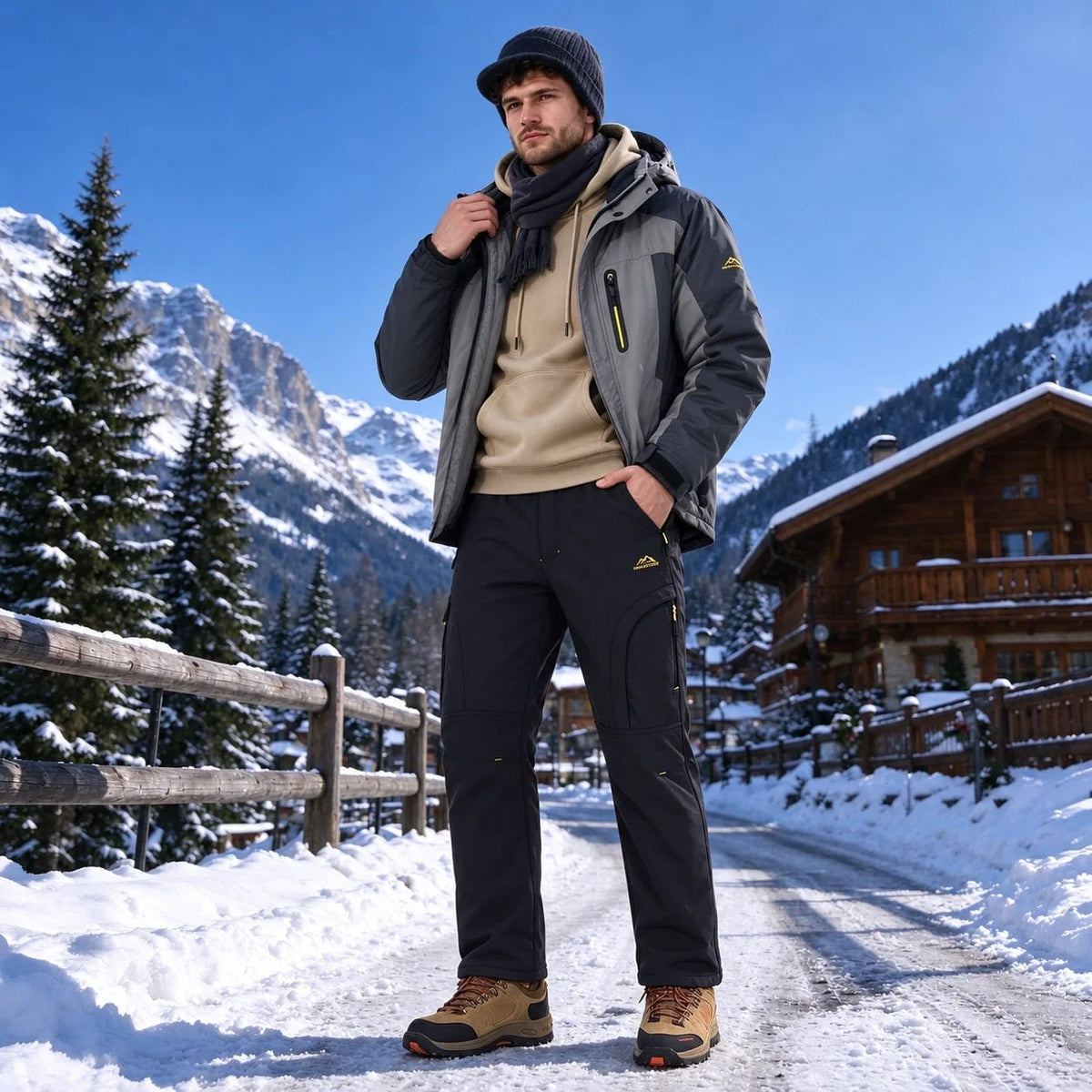
Cold legs on a winter hike can have several causes: low temperatures, wind, damp layers, long stops, or snow getting into your boots. Winter hiking pants matter, but so do the layers beneath them and the pace of your hike. Here’s how to identify what is making your legs cold before choosing a fix.
Four things decide whether your legs stay warm:
- How hard you're working — a steep climb generates several times more body heat than standing still.
- How long you stand still — past roughly 10 minutes, your legs stop producing heat faster than thin pants can hold it.
- How deep the snow is — once it's above your ankle, keeping snow out matters more than adding insulation.
- What the terrain asks of your stride — logs, scree and steep steps punish stiff fabric.
Sort those four out and you fix all four problems below. Get one wrong and no amount of extra fleece will save the hike.
Problem 1: You Sweat on the Climb, Then Freeze on the Way Down
Why it happens. The ascent generates serious body heat, so your legs heat up, you sweat, and the moisture soaks into your base layer and pants. The moment you slow down or turn downhill, that wet fabric starts pulling heat off your skin — wet fabric moves heat away far faster than trapped still air does.
You're not cold because it's cold. You're cold because you're wet.
The fix isn't a warmer pant — it's a setup you can adjust. Here's where most winter hiking pants land:
| Conditions | Below-the-waist setup |
|---|---|
| Above freezing, sustained climbing | Regular hiking pant + light moisture-wicking base layer. Skip the heavy lining. |
| Around 0°C / 32°F, mixed pace | Breathable stretch softshell. Add insulation only if you'll be stopped for a while. |
| Below roughly ‑5°C / 23°F, or you always run cold | This is the one case where a fleece-lined pant earns its keep. |
If you tend to overheat, look for stretch fabrics that breathe. If you always run cold, that's when a lining pays off — our full guide on choosing fleece-lined pants breaks down exactly when that lining helps.
The trade-off: insulation that feels great at the trailhead becomes a sweat sponge twenty minutes into the climb. Warmth you can't shed is worse than no warmth at all — so on days you're moving hard, prioritise venting and breathability over thickness.
One absolute rule: no cotton base layer. Cotton holds moisture against your skin and loses nearly all of its insulating value once wet. Synthetic and merino both keep working when damp; cotton doesn't.
Problem 2: You Stop for More Than a Few Minutes and Your Knees Go Cold
Why it happens. Knees are the first thing to freeze on a winter hike — less muscle, less circulation, and usually less coverage than your thighs. When you stop for lunch or a view, your legs stop producing heat, and thin pants won't hold what you've lost. 
The fix. If your route has real rest stops, plan for them. Something with insulation or a wind-resistant outer layer makes a measurable difference within the first five minutes of standing still. Rough thresholds:
- Stops under about 5 minutes — what you're wearing is fine, keep moving.
- Stops over 10 minutes — you need insulation or a shell you can pull on. A packable wind-resistant overpant weighs almost nothing and won't overheat you on the climb.
- Standing around in snow — insulated or fleece-lined pants are the difference between enjoying the break and cutting it short.
The trade-off: a dedicated leg base layer is dead weight on a fast climb. Most hikers don't need one until temperatures sit below freezing — or until the wind picks up. Wind strips heat out of fabric faster than cold air alone, and it hits your least-covered joints first.

Problem 3: Snow Keeps Sneaking Into Your Boots
Why it happens. Loose pant cuffs are a snow magnet. Two steps into fresh powder and you've got snow inside your boot, melting into a cold puddle — and by then your socks are the problem, not your pants.
The fix, in order of what actually works:
- Close the cuff. Drawcord, elastic or a tapered hem — anything that seals at the ankle instead of flaring open.
- Pants over your boot tops, not tucked in. Tucking creates a funnel that channels meltwater straight down into the boot.
- Add gaiters on deep days. This is the highest-impact piece of winter leg gear for the money. If you're postholing or breaking trail, nothing else comes close.
- Go water-resistant in wet snow. A DWR-finished pant sheds slush without feeling like a ski bib — and it still breathes when you're climbing.
The trade-off: fully waterproof membranes (sealed seams, ski-pant construction) do keep snow out, but they trap sweat on the climb. For winter hiking — where you alternate hard effort and standing still — breathable water resistance almost always beats full waterproofing.
Problem 4: Your Pants Fight Your Stride
Why it happens. Ever try to step over a fallen log in a stiff pant? That restriction is a real winter hazard — you compensate with awkward movements, and on snow or ice that's how ankles get rolled.
The fix — check the pant, not your body. Before you blame the fit on yourself, you want all three of these:
- Gusseted crotch — that extra diamond-shaped panel that lets you high-step without the fabric binding
- Articulated knees — a pre-shaped bend that follows a bent leg instead of fighting it
- Stretch fabric — ideally with a little elastane; it's what lets one pair work for both scrambling and standing around
Missing any one of those means the pant is working against you on uneven terrain. 
The trade-off: heavy insulated pants are almost always stiffer. If your winter routes involve scrambling, a lighter softshell plus a separate insulation layer moves better than one thick pair.
Three Winter Leg Setups That Actually Work
Rules are easier to apply once they're attached to actual gear. The three setups below are built around MAGCOMSEN pieces — pick the one that matches how you actually hike:
Setup 1 — The Climber: fast, hot, minimal stops
- Target conditions: sustained ascent, few breaks, above-freezing starts
- Selected gear: synthetic base layer + Men's Lightweight Quick-Dry Hiking Joggers
- Technical application: a 92% polyester / 8% spandex blend dries fast and moves with you; tapered, cuffed ankles keep light powder out. Nothing here adds loft you can't shed mid-climb.
Setup 2 — The Stop-and-Go Hike: photos, lunch, slow company
- Target conditions: intermittent effort with regular stops over 10 minutes, snow underfoot
- Selected gear: Men's Winter Hiking Pants — fleece-lined, water-resistant ripstop softshell
- Technical application: the fleece lining covers your stationary gaps, while the water-resistant ripstop outer handles wind, snow and gravel. Five zippered pockets mean you don't bare your hands every time you need the map.
Setup 3 — The Deep Snow Day: breaking trail
- Target conditions: snow above the ankle, heavy or wet snow
- Selected gear: Men's Fleece-Lined Softshell Pants + gaiters
-
Technical application: the water-resistant, windproof outer sheds slush before it melts into your socks, and the 3D ergonomic cut keeps your stride free when every step is a high step. Add gaiters and the cuff problem disappears entirely.

Quick Reference: Which Fix You Actually Need
| Problem | When you'll hit it | Fix | Don't do this |
|---|---|---|---|
| Sweat then freeze | Steady climbs, hard effort | Light hiking pant + moisture-wicking layer; skip the heavy lining on moving days | Pull on more insulation mid-climb — you're compounding the wetness |
| Cold knees at stops | Rest stops longer than about 10 min | Insulated or fleece-lined pants, or a packable wind-resistant shell | Stand around for 20 minutes in thin softshell and hope for the best |
| Snow in boots | Fresh powder, slush, postholing | Closed cuffs → pants over boot tops → gaiters | Tuck pants into boots and create a funnel |
| Restrictive stride | Logs, rocks, steep terrain | Gusseted crotch + articulated knees + stretch fabric | Size up to get movement — you lose the close fit instead |
| Wet through from the inside | Any hike with a cotton layer next to skin | Swap to synthetic or merino | Wear cotton "because it's only a short hike" |
FAQ
What pants should I wear hiking in winter?
It depends on how hard you're moving. For most winter hikes, start with a moisture-wicking synthetic base layer under a regular hiking pant or softshell. Add fleece-lined or insulated winter hiking pants only when you'll be stopping in the cold for long stretches.
What are the best hiking trousers for cold weather?
Breathable stretchy pants for active days, fleece-lined or insulated options for slow, stop-heavy days, and water-resistant softshells for wet snow. No single pair wins all three, which is why a two-layer setup usually beats one thick pair.
Are snow hiking pants the same as ski pants?
No. Snow hiking pants are cut for walking — lighter, more breathable, with freer knees and hips — while ski pants add insulation and waterproofing built for sitting on a chairlift. For winter hiking, that extra bulk usually overheats you on the climb.
How do I keep snow out of my hiking boots?
In priority order: close your ankle cuffs, run your pants over your boot tops rather than tucked in, then add gaiters for anything deeper than ankle-height snow. Water-resistant fabric helps in wet snow, but it won't replace a gaiter.

Leave a comment
This site is protected by hCaptcha and the hCaptcha Privacy Policy and Terms of Service apply.